
Choose the finish before the machine arrives
| Your goal | Useful method | What remains |
|---|---|---|
| Open brushy property or trails | Forestry mulching | A wood-mulch surface; roots and some stumps remain. |
| Create lawn or planting ground | Clearing plus root/debris removal and soil preparation | A seedbed prepared separately from the mulch layer. |
| Prepare a building or driveway | Remove organics and unsuitable ground to the project plan | Structural support cannot be built on buried mulch and roots. |
| Remove a few stumps | Grinding or excavation, depending on next use | Grinding leaves chips/roots; excavation removes more of the root mass. |
How our TL10V2 mulching setup works
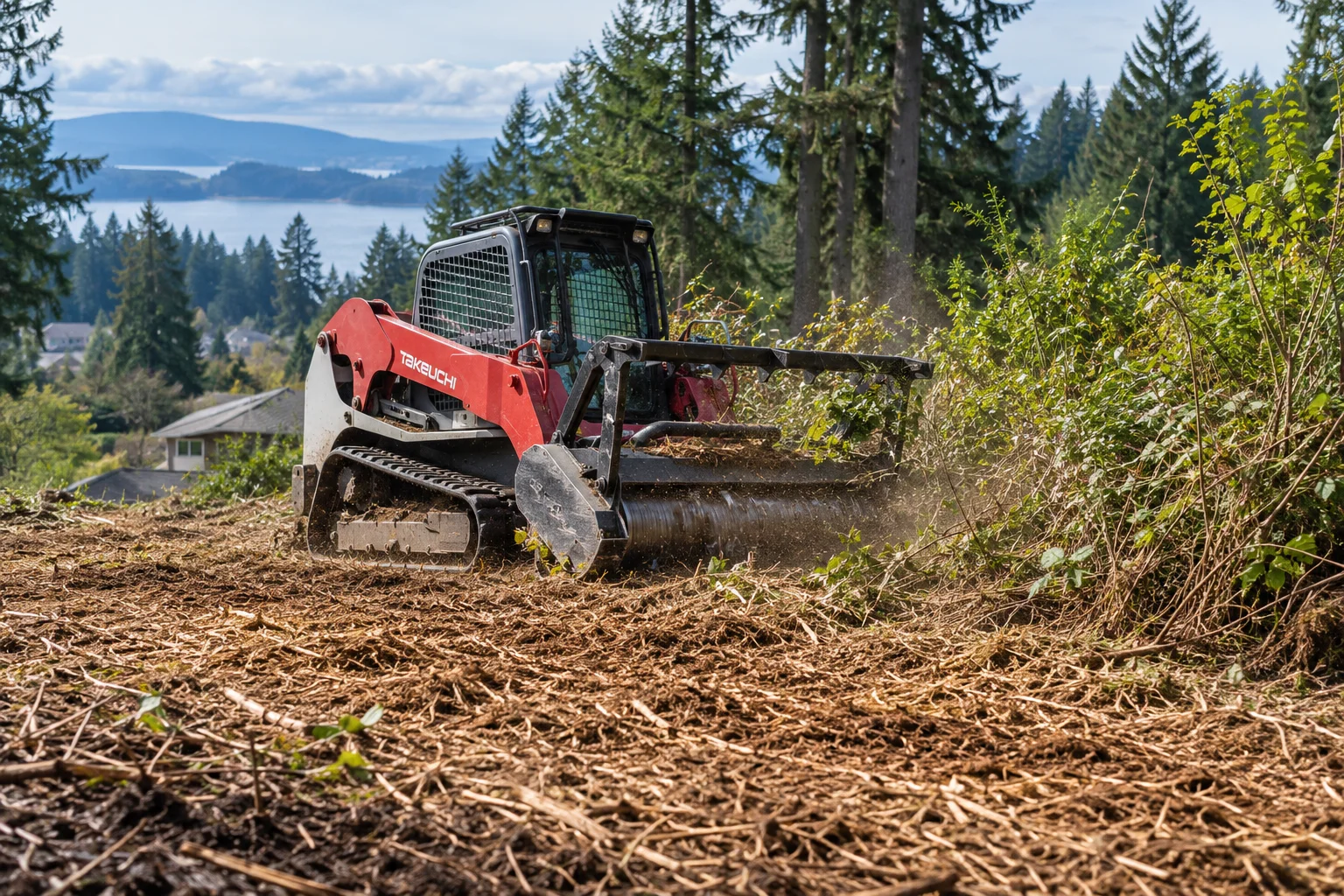
Western Landworks uses a Takeuchi TL10V2 with a forestry mulcher to process suitable brush and saplings into material left on site. A powered cutting drum works through vegetation in controlled passes. Additional passes reduce and spread the debris for a more even woodland finish.
Combining cutting and processing can be faster than separately cutting, piling, loading and hauling every branch. Leaving suitable mulch on the property can reduce trucking and disposal fees. Actual production depends on stem size, species, density, slope, rocks, access and the finish requested; it is not a fixed acreage-per-day promise.
Clearing in the right order
- Mark what stays. Flag retained trees, property limits, utilities, septic components and areas excluded from clearing. Confirm wetland, stream and slope restrictions where relevant.
- Inspect the ground. Look for wire, fencing, dumped debris and hidden metal. These can damage the attachment or become projectiles.
- Plan access and work limits. Keep people and vehicles outside the attachment manufacturer’s exclusion distance. Never approach an operating mulcher for a photo.
- Clear in controlled passes. Work around retained trees without scraping roots or trunks. Large trees, hazardous trees and material beyond the attachment’s capability need another method.
- Manage the residue. Spread suitable mulch; avoid deep piles around trees, drainage inlets or future lawn/pad areas. Keep drain paths open.
- Plan follow-up. Some plants regrow from roots. Schedule mowing, selective cutting or other suitable control instead of assuming one pass prevents all regrowth.
Mulching, stumps and new construction
Mulching is not the same as removing every root. If a shed, driveway or lawn is next, budget for the additional clearing and grading needed beneath it. Stump grinding can suit landscape areas, but chips left in a hole settle as they decay. For a structural pad, the planned bearing area needs the specified removal and backfill.
Why leave mulch instead of burning or hauling?
A reasonably spread mulch layer can cover bare soil and improve the appearance of a cleared wooded area. It also avoids some handling and disposal. Keep it away from structures and apply the appropriate wildfire defensible-space practices for the property.
Land-clearing fires are prohibited in Kitsap County. Mason County land-clearing burning depends on location, permits and current restrictions; it is not allowed everywhere. Check the linked local rules for the actual project date. Mulching avoids relying on permission to burn.
Use your own measurements and adjust the product assumptions before ordering.
Open the materials calculator →Questions for the estimate
- Is the price for brush mulching, stump removal, or a fully graded surface?
- Which trees and areas will be left untouched?
- How fine and even will the remaining mulch be?
- Are metal removal, hauling and follow-up regrowth work included?
Further reading & product instructions
Residential resources used for these explanations. Follow the instructions for the product you actually choose.